
Grape Seed Extract Buying Guide | How To Pick Stable 95% OPC Raw Material For Supplements & Cosmetics
Grape Seed Extract Buying Guide: Avoid 4 Common Pitfalls When Sourcing 95% OPC Raw Material
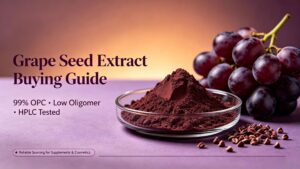
Introduction: Why Grape Seed Extract Remains A Top-Selling Natural Antioxidant Raw Material Globally
According to the 2026 Global Plant Extract Market Research Report, the global grape seed extract market size is expected to exceed USD 403 million by 2034, with a compound annual growth rate of 7.8%. It is a mainstream natural polyphenol raw material widely demanded across three major sectors: dietary supplements, skincare cosmetics and functional beverages.
Grape seeds are by-products of wine brewing, counted as sustainable circular plant raw materials with stable supply and controllable cost. Its signature active ingredient, Proanthocyanidins (OPC), is a natural polyphenol antioxidant recognized by the nutrition industry. The human body cannot synthesize proanthocyanidins independently, and daily fruits and vegetables only contain trace amounts. Standardized purified grape seed extract has become the core raw material for brands to develop “natural antioxidant” formulas.
However, most bulk buyers report widespread chaos in this industry: falsely labeled OPC content, fillers of high-polymer tannins, excessive solvent residues, unstable active ingredients per batch, and incomplete export compliance documents. These issues result in unqualified finished goods testing, customs detention, poor customer repurchase rates and irreversible damage to brand reputation.
This article fully unpacks raw material principles, sourcing traps, production standards, application scenarios and factory supply support, all content complying with GB food standards, EFSA and FDA regulations without exaggerated efficacy claims. It helps bulk purchasers screen reliable, stable grape seed extract suppliers efficiently.
1. Must-Know Basic Knowledge For Grape Seed Extract Buyers
1.1 Raw Material Source & Core Active Components
Botanical Source: Dried mature seeds of Vitis vinifera L., by-product of wine production with year-round stock reserves for large-scale manufacturing.
Key Active Ingredient: Proanthocyanidins (OPC), divided into two categories:
1. Low oligomeric proanthocyanidins (polymerization degree 2-5, molecular weight <1000Da): High water solubility, easy intestinal absorption, the core component that determines actual raw material value.
2. High polymeric proanthocyanidins (polymerization degree ≥5): Large molecular weight with low human absorption, only metabolized as dietary fiber. Many low-cost suppliers add massive high-polymer tannins to inflate total polyphenol readings, resulting in low-performance finished goods despite high labeled OPC content.
Common Standard Specification: Proanthocyanidins ≥95% (UV / HPLC double test versions), fine reddish-brown powder with good fluidity, no caking, mildew or impurities.
1.2 Objective Physicochemical Properties
Proanthocyanidin molecules are rich in phenolic hydroxyl groups, which can neutralize reactive oxygen species and block oxidative chain reactions, presenting natural free radical scavenging properties. It owns both water-soluble and fat-soluble characteristics, supporting multiple oral and external dosage forms.
EFSA and China’s Food Raw Material Catalog both recognize proanthocyanidins as antioxidant ingredients for dietary balance maintenance. In cosmetic formulations, it acts as a natural antioxidant stabilizer to slow oil oxidation and extend shelf life of skincare products.
1.3 Two Critical Sourcing Misconceptions
Misconception 1: Only focus on total OPC value, ignore low-oligomer proportion
Nearly half of grape seed extracts on the market mark 95% OPC, yet low-oligomer content accounts for less than 30%, filled with useless high-polymer tannins. End products fail to deliver expected antioxidant performance and face high return rates. Reliable raw materials must guarantee low oligomeric OPC ≥70%.
Misconception 2: Low price equals high cost performance
Cheap grape seed extracts carry three major risks: excessive edible ethanol solvent residues, heavy metal & microorganism out-of-limits, high-temperature extraction destroying polyphenol activity. Severe batch color fluctuation increases factory waste and long-term production costs.
UV vs HPLC Grape Seed Extract Comparison Table
| Test Method | Detection Target | Suitable Application | Disadvantages |
| UV Test | Total polyphenols (contains high polymer tannins) | Low-cost functional food, general cosmetics | Mixed high polymer tannins, low absorption efficiency |
| HPLC Test | Pure low oligomeric OPC only | High-end supplements, export nutrition products | Slightly higher production cost, accurate active ingredient quantification |
2. Four Major Pain Points Faced By Grape Seed Extract Purchasers
Pain Point 1: Falsified content, inconsistent lab test results
Industry sampling inspection shows nearly half of grape seed extract products have measured OPC content far below labeled values. Some manufacturers adulterate maltodextrin and cheap bark extracts, leading to regulatory penalties and brand reputation loss after finished product testing.
Pain Point 2: Undefined low-oligomer ratio, lack of product differentiation
Raw materials rich in high polymers have low absorption efficiency. End brands cannot launch competitive “high absorption natural antioxidant” selling points, forced into vicious price competition with shrinking profit margins.
Pain Point 3: Non-compliant production triggers export risks
Small workshops adopt high-temperature extraction and industrial solvents, resulting in over-limit solvent residues and heavy metals. Without complete COA, MSDS and microbial test reports, goods get detained by customs in Europe, America and Southeast Asia, delaying production schedules.
Pain Point 4: Unstable raw material supply affected by seasonal harvest
Grape seed raw materials rely on annual wine grape harvest with short concentrated supply windows. Most small manufacturers lack large raw material storage, leading to price hikes and stockouts in peak seasons, halting client production lines.
3. Standardized High-Quality Grape Seed Extract Solutions From Our Factory
3.1 Low-Temperature Green Extraction Preserves High-Activity Low-Oligomer OPC
We adopt food-grade ethanol-water dual-phase low-temperature extraction technology with the whole process controlled below 50°C to avoid high-temperature damage to polyphenol structures. Multi-stage chromatographic separation removes macromolecular high-polymer tannins, stabilizing low oligomeric proanthocyanidins above 75%. HPLC full spectrum reports are provided for each batch with transparent, unmodified test data.
Solvents strictly comply with GB2760 food standards, ethanol residue ≤10mg/kg, far below national limits. No benzene, chloroform or other harmful solvent residues, complying with food and cosmetic regulations worldwide.
3.2 GMP Standard Workshop Ensures Consistent Batch Quality
Self-owned standardized extraction workshop and independent CNAS-certified laboratory implement full-link quality inspection from raw material warehousing, extraction, concentration, spray drying to packaging. We lock grape seed raw material reserves annually with 10,000-ton storage capacity, eliminating seasonal stockouts and price surges for year-round stable supply.
Uniform fine reddish-brown powder with good fluidity, low moisture absorption and anti-caking performance. Even dispersion in tablets, oral liquids and skincare formulas reduces filtration waste during production.
3.3 Full Set Of Global Export Compliance Documents For Smooth Customs Clearance
Certifications including SC food production license, ISO9001, ISO22000, HALAL, KOSHER are available. Each batch provides COA, MSDS, TDS, heavy metal & microbial test reports to meet factory audits, customs clearance and product filing requirements in the US, EU, Southeast Asia and Australia.
3.4 Customizable Specifications For Full-Range Formula Development
In-Stock Regular Grades: 95% OPC (UV test), 95% OPC (HPLC test)
Customizable Options: High-purity low-oligomer OPC extract, water-modified grape seed extract, low-tannin deastringent grade
Support small sample trial orders and mass industrial production; standard 25kg export fiber drums with neutral packaging customization. 1kg-5kg sample split packaging available.
4. Compliant Global Application Fields Of Grape Seed Extract
4.1 Dietary Supplements
Applicable Products: Antioxidant compound tablets, capsules, multi-mineral powder, sports nutrition powder, women’s oral maintenance granules
Compliance Note: Added as natural polyphenol antioxidant raw material; only label “rich in natural proanthocyanidins” without medical treatment or whitening efficacy claims, matching global dietary supplement raw material standards.
4.2 Functional Food & Beverages
Applicable Products: Solid drink powder, meal replacement shakes, polyphenol tea, fruit juice, sparkling functional drinks, baking nutrition powder
Compliance Limit: Follow local food additive dosage standards, maximum 0.08g/kg added in liquid drinks, converted by dilution ratio for solid formulas; only mark as natural plant polyphenol material on labels.
4.3 Skincare & Personal Care Cosmetic Raw Material
Applicable Products: Antioxidant serum, face cream, facial mask, body lotion, washing care supplies
Functional Characteristic: Natural antioxidant stabilizer to delay oil rancidity and extend cosmetic shelf life. Mild plant polyphenol suitable for sensitive skin repair formulas, a mainstream clean beauty raw material.
4.4 Laboratory Research Raw Material
High-purity graded grape seed extract with low impurities and low tannins, suitable for polyphenol-related protein and cell experiments in universities and biological labs.
5. Frequently Asked Sourcing Questions
Q1: What is the difference between 95% UV and 95% HPLC grape seed extract? How to choose?
A: UV testing only measures total polyphenols without distinguishing low/high polymer OPC; HPLC precisely quantifies active low-oligomer components.
– Skincare & low-cost food: Choose standard UV 95% grade
– High-end dietary supplements, export nutraceuticals, products highlighting high absorption: Prioritize HPLC tested grade with transparent low-oligomer content to boost end product competitiveness.
Q2: Can grape seed extract be used in maternal and teenage nutrition formulas?
A: It can be used within compliant dosage limits; daily total proanthocyanidin intake shall not exceed 150mg. We can provide samples for third-party testing and safety evaluation before formula development to avoid regulatory risks.
Q3: Do you support free samples? How long for sample delivery and bulk order lead time?
A: Free 10-50g samples available with freight collect; samples shipped within 12 hours. Standard in-stock specifications deliver within 7-10 working days, customized purified grades take 15 days. Long-term cooperative clients enjoy priority production scheduling.
Q4: Storage conditions, shelf life and transportation stability of bulk goods?
A: Seal and store in cool, dry, dark warehouses with 24-month room-temperature shelf life. Standard 25kg fiber drums lined with double-layer vacuum aluminum foil bags, moisture and oxygen isolation. Powder remains stable without discoloration or oxidation during long-distance sea and land transportation.
6. Why Source Grape Seed Extract Directly From Our Factory?
1. No middleman markup, 10,000-ton raw material reserves to lock prices and stock in peak seasons, controlling your raw material cost.
2. Self-owned laboratory supports customized purification and modification formulas, with professional technical guidance for compound matching.
3. One-stop supply of full compliance documents to assist overseas product filing and customs clearance.
4. 15 years of plant extract export experience, stable service for food, beauty and nutrition factories across more than 30 countries, with abundant mature formula cases for reference.
Contact Us For Samples & Quotation
If you are searching for grape seed extract with stable batches, transparent low-oligomer OPC content and complete export qualifications for new formula upgrades or existing product replacement, feel free to contact us to get free samples, full COA test reports and detailed quotation sheets.
Our professional technical team provides formula matching suggestions based on your end dosage forms (oral liquid / tablets / skincare essence), solving production challenges including solubility, compound precipitation and compliance labeling.
Internal Link 1: Click to enter Grape Seed Extract Product Page for full specification data
Disclaimer
This article only objectively introduces the physicochemical properties, extraction technology, industry applications and sourcing standards of grape seed extract. Antioxidant descriptions refer to the inherent physical and chemical characteristics of polyphenol substances, and do not constitute any claims of disease treatment or cosmetic efficacy. All finished products must comply with food, cosmetic and dietary supplement laws and regulations of target sales regions before launch.